
-
 Products
Shanghai armored shield plastic technology co., ltd, brand "armored shield", is a production-oriented enterprise focusing on the research and development, design, customization, production, sales and service of special safety protection boxes; "armored shield" aims to provide integrated packaging protection solutions for major instrument and equipment manufacturers, aerospace, fire protection, medical and other industries.
-
 Case
CaseShanghai armored shield plastic technology co., ltd, brand "armored shield", is a production-oriented enterprise focusing on the research and development, design, customization, production, sales and service of special safety protection boxes; "armored shield" aims to provide integrated packaging protection solutions for major instrument and equipment manufacturers, aerospace, fire protection, medical and other industries.
-
 Customized
Shanghai armored shield plastic technology co., ltd, brand "armored shield", is a production-oriented enterprise focusing on the research and development, design, customization, production, sales and service of special safety protection boxes; "armored shield" aims to provide integrated packaging protection solutions for major instrument and equipment manufacturers, aerospace, fire protection, medical and other industries.
-
 Technical Q & A
Shanghai armored shield plastic technology co., ltd, brand "armored shield", is a production-oriented enterprise focusing on the research and development, design, customization, production, sales and service of special safety protection boxes; "armored shield" aims to provide integrated packaging protection solutions for major instrument and equipment manufacturers, aerospace, fire protection, medical and other industries.
-
 About
AboutShanghai armored shield plastic technology co., ltd, brand "armored shield", is a production-oriented enterprise focusing on the research and development, design, customization, production, sales and service of special safety protection boxes; "armored shield" aims to provide integrated packaging protection solutions for major instrument and equipment manufacturers, aerospace, fire protection, medical and other industries.
-
 Contact
Shanghai armored shield plastic technology co., ltd, brand "armored shield", is a production-oriented enterprise focusing on the research and development, design, customization, production, sales and service of special safety protection boxes; "armored shield" aims to provide integrated packaging protection solutions for major instrument and equipment manufacturers, aerospace, fire protection, medical and other industries.
What are the features and application functions of the second-generation side-opening universal medical kit?
1. Basic Definitions and Classification & Positioning
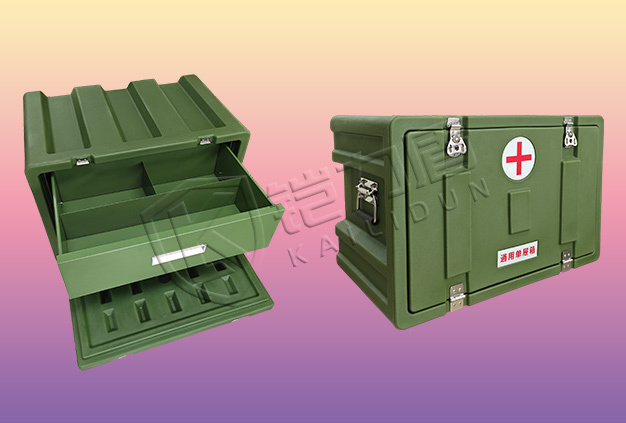
Type Attribution The hollow‑box belongs to the “General‑Purpose Box” category within the second‑generation Army field medical‑kit family, standing alongside the “Single‑Drawer General‑Purpose Box” as the two core configurations of the general‑purpose box series.
Design Positioning : Designed specifically to accommodate non-standard‑shaped or large‑volume medical devices, the case features internal drawers or tiered compartments and can also maintain a fully open cavity to meet diverse instrument‑loading requirements.
2. Core Functional Features
Large Equipment Compatibility : Primarily used for stowing medium-sized medical devices that require substantial internal space, such as portable high-pressure sterilizers and surgical irrigation units, as well as modular combat‑first‑aid equipment.
Scalable Applications : During rapid battlefield deployment, it can be stacked and combined into an operating table or storage cabinet, enabling a “box‑table‑cabinet” functional transformation and allowing the medical support team to flexibly configure its layout according to treatment needs.
Protection and Mobility The enclosure is made of high-strength engineering plastic (such as impact-modified PP), offering waterproof and dustproof performance to withstand harsh environments like mountainous regions and cold climates. The raised top beam and recessed bottom groove facilitate secure stacking and convenient transport by road or air.
3. Structural Design Details
Size specifications : The external dimensions are standardized at 600 mm (±50) in length × 400 mm (±50) in width × 425 mm (±30) in height, ensuring compatibility with other units in the cabinet assembly, such as dedicated enclosures and worktop panels.
Internal structure : It features built-in compartments or drawers with smooth inner walls; some models may include cushioning material‑secured slots or removable liners to protect equipment from shock (e.g., polyethylene foam liners designed for liquid‑filled glass bottles).
Sealing and Reinforcement The lid features a snap-lock closure combined with a sealing gasket, enhancing airtightness and impact resistance to meet the demands of airdrops or underwater towing.
4. Application Scenarios and Practical Value
Rapid battlefield deployment : As the core platform for medical supplies at the division, brigade, or regimental level, it supports casualty care in areas lacking infrastructure, and can be combined with tabletops to serve as an operating table or a medication‑preparation station.
Dedicated transport for special equipment For precision instruments (such as disinfection equipment and diagnostic analyzers), customized cushioning and securing solutions—like rigid polyethylene foam trays—are employed to ensure vibration resistance and prevent damage during transportation.
Joint Assurance Scenario : When used in conjunction with the second-generation container system’s “dedicated box‑tray containers,” “medical record boxes,” and other components, it forms a comprehensive medicinal‑material supply chain that covers the entire clinical care process—from drug storage to equipment operation.
5. Relationship of the Supporting Box Group
The cavity box is one of the basic units of the second-generation field medical kit and is used in conjunction with the following components:
Stacking combination It can be combined with 2 to 4 universal boxes, 1 dedicated box, and a workbench top to form either a “three-box‑one‑bench” or a “five-box‑one‑bench” work platform.
System Integration : In the “Tent Hospital Container Unit,” it serves as an equipment storage and transport module, supporting modular deployment into functional zones of a field hospital (such as a disinfection zone and a surgical zone).
Table of Main Technical Parameters for the Second-Generation Universal Cavity Box
Project |
Parameter/Description |
Size |
600 × 400 × 425 mm |
Main uses |
Loading large equipment (sterilizers, rinsers, etc.) |
Structural features |
Drawerless full‑cavity design (with optional drawer), high‑strength engineering plastic housing |
Protective performance |
Shock-absorbing design, waterproof and dustproof, with a temperature tolerance of 25°C to 80°C. |
Combination method |
Supports multi-layer stacking, enabling the creation of a “three bins per board” operating platform. |
Summary
The second-generation universal cavity container leverages a “large-capacity, partition-free design with high compatibility” as its core advantage, focusing on addressing the field‑portable storage and protection needs of large‑sized or irregularly shaped medical equipment. Its standardized dimensions and modular architecture make it a critical platform within the Army’s medical support system, enabling seamless integration of peacetime and wartime operations and ensuring rapid response, thereby significantly enhancing the compatibility of medical equipment and the efficiency of deployment in combat environments.
Key words:
rotomolding airdrop box | safety protection box | server rack box | aviation aluminum box | cold chain insulation box | fire cart
RELATED INFORMATION



A production-oriented enterprise focusing on the research and development, design, customization, production, sales and service of special safety protection boxes; "armored shield" aims to provide integrated packaging protection solutions for major instrument and equipment manufacturers, aerospace, fire protection, medical and other industries.


Contact Us
Service Hotline: 139-1747-5956
Service Hotline:137-6128-2604
E-mail:sales@kldcases.com
Company address: 703A, Building A8, Kangqiao Business Oasis, caohejing, Pudong New Area, Shanghai
Factory address: 500 Yedao Road, Xitangqiao Town, Haiyan County, Jiaxing City, Zhejiang Province

Sweep and add WeChat
Learn more about products
Links: