
-
 Products
Shanghai armored shield plastic technology co., ltd, brand "armored shield", is a production-oriented enterprise focusing on the research and development, design, customization, production, sales and service of special safety protection boxes; "armored shield" aims to provide integrated packaging protection solutions for major instrument and equipment manufacturers, aerospace, fire protection, medical and other industries.
-
 Case
CaseShanghai armored shield plastic technology co., ltd, brand "armored shield", is a production-oriented enterprise focusing on the research and development, design, customization, production, sales and service of special safety protection boxes; "armored shield" aims to provide integrated packaging protection solutions for major instrument and equipment manufacturers, aerospace, fire protection, medical and other industries.
-
 Customized
Shanghai armored shield plastic technology co., ltd, brand "armored shield", is a production-oriented enterprise focusing on the research and development, design, customization, production, sales and service of special safety protection boxes; "armored shield" aims to provide integrated packaging protection solutions for major instrument and equipment manufacturers, aerospace, fire protection, medical and other industries.
-
 Technical Q & A
Shanghai armored shield plastic technology co., ltd, brand "armored shield", is a production-oriented enterprise focusing on the research and development, design, customization, production, sales and service of special safety protection boxes; "armored shield" aims to provide integrated packaging protection solutions for major instrument and equipment manufacturers, aerospace, fire protection, medical and other industries.
-
 About
AboutShanghai armored shield plastic technology co., ltd, brand "armored shield", is a production-oriented enterprise focusing on the research and development, design, customization, production, sales and service of special safety protection boxes; "armored shield" aims to provide integrated packaging protection solutions for major instrument and equipment manufacturers, aerospace, fire protection, medical and other industries.
-
 Contact
Shanghai armored shield plastic technology co., ltd, brand "armored shield", is a production-oriented enterprise focusing on the research and development, design, customization, production, sales and service of special safety protection boxes; "armored shield" aims to provide integrated packaging protection solutions for major instrument and equipment manufacturers, aerospace, fire protection, medical and other industries.
How does a polyethylene snow-melting spreader adapt to different operational requirements?
The polyethylene snow-melting spreader, leveraging intelligent control, modular design, and multi‑scenario adaptation technologies, delivers precise responses to diverse operational requirements. Based on a comprehensive review of available findings, its core strategic approach can be summarized into the following five key areas:
I. Intelligent Control System: Dynamically Adapts to the Operating Environment
Precise adjustment of spreading parameters
Width and Rate Control: The cab-mounted control unit allows independent adjustment of the spreading width (2–20 meters) and spreading rate, employing stepless speed regulation to accommodate changes in vehicle speed and ensure a consistent application rate per unit area.
Spraying height optimization: Equipped with a height sensor, the system dynamically adjusts the spray height based on road undulations and wind speed, minimizing drift and waste of de-icing agents (e.g., through wind‑control technology combined with angle optimization).
Intelligent Decision-Making System
GPS–Weather Integration: High-end models integrate GPS positioning with meteorological data to automatically generate de-icing strategies, such as pre‑application before snowfall or increasing the de-icing agent concentration during freezing rain.
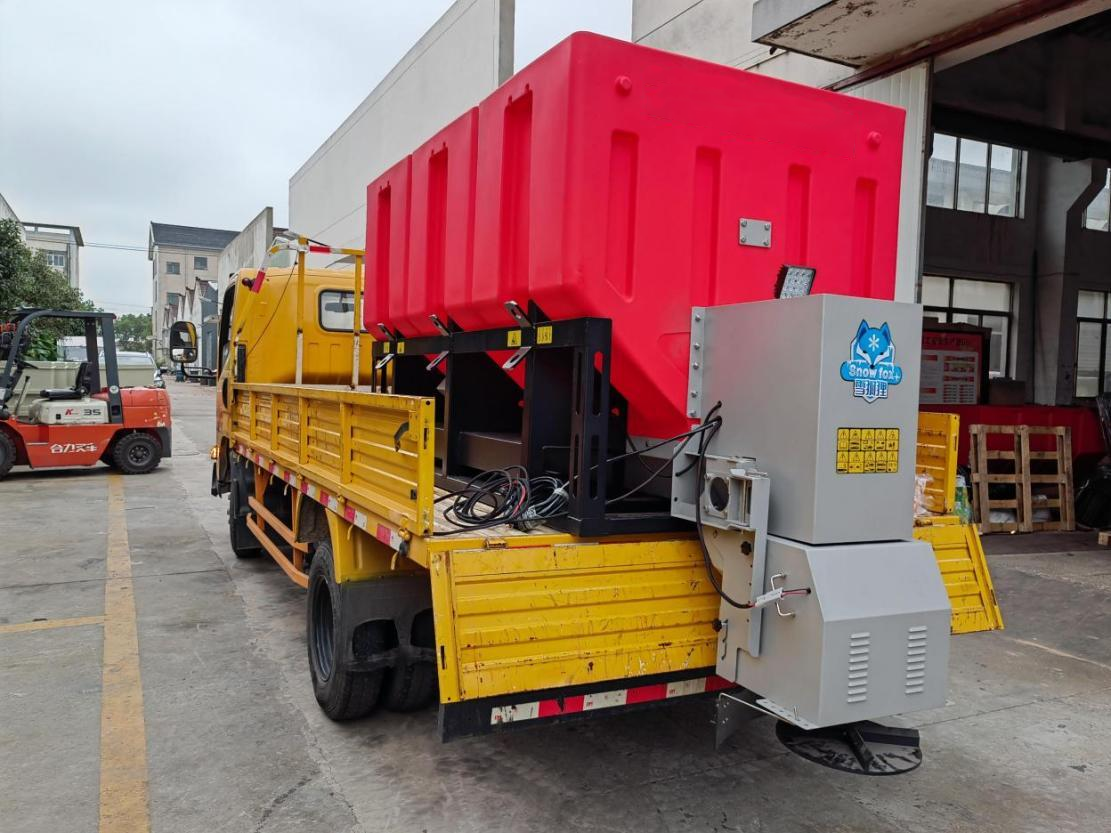
II. Multifunctional Hardware Design: Compatible with Multiple Types of Materials and Terrains
Innovative Spreading Device
Rotary-disc–blade synergistic system: The surface of the spreading rotary disc is equipped with slots inclined at 30°, which precisely engage with the curved blades to ensure uniform distribution of materials with varying particle sizes, such as coarse salt, fine salt, and dry sand.
Dual‑drive control: independent speed regulation of the conveyor chain and the spreading disc (fully hydraulically driven), designed to handle viscous de-icing agents or low‑temperature caking conditions.
Material and Structural Optimization
Corrosion‑resistant hopper: Featuring a polyethylene or carbon‑steel corrosion‑resistant liner to prevent deicing agents from damaging the equipment and extend its service life.
Modular loading and unloading: The hopper can be quickly detached, and during the off‑season it can be converted into a maintenance‑material transport vehicle, thereby increasing equipment utilization.
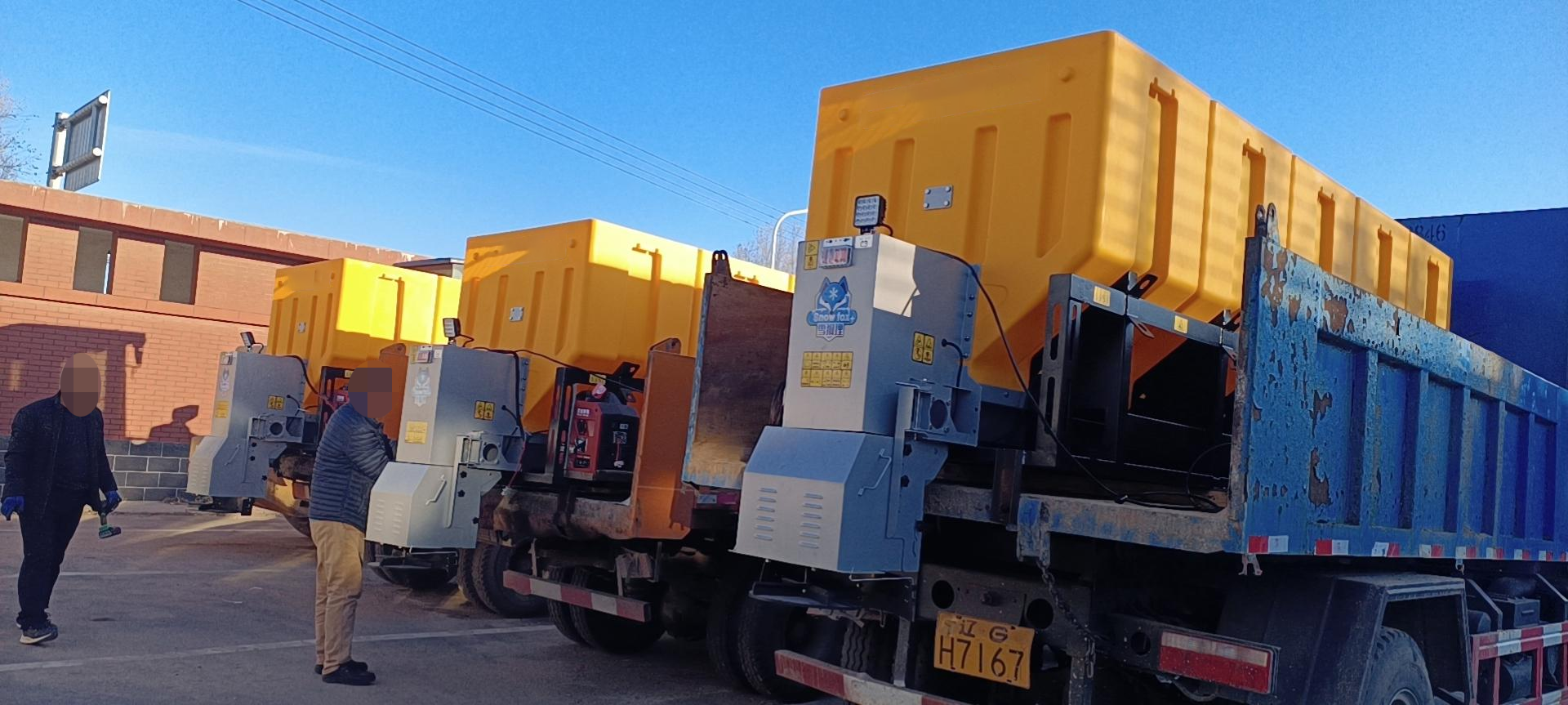
III. Multi-Scenario Adaptation Solutions
| Scene Type |
Countermeasures |
Technical Support |
| Urban roads |
Narrow-width operations (2–5 meters) combined with low-speed spreading to avoid disrupting pedestrians and vehicles. |
Electronically controlled narrowing of the spreading range + Nighttime silent mode |
| Highway/Bridge |
Wide‑width spreading (10–20 m) + pre‑spreading anti‑icing strategy |
Vehicle-mounted large-capacity hopper (7 m³) + Intelligent predictive system |
| Airport/Plaza |
High uniformity requirements; corrosive de-icing agents are prohibited. |
Dedicated channel for specialized de-icing agents + encrypted control of disc rotation speed |
| Backstreets and alleyways |
Auxiliary operation for small hand-pushed spreaders |
Operate in coordination with large-scale equipment to achieve full coverage. |
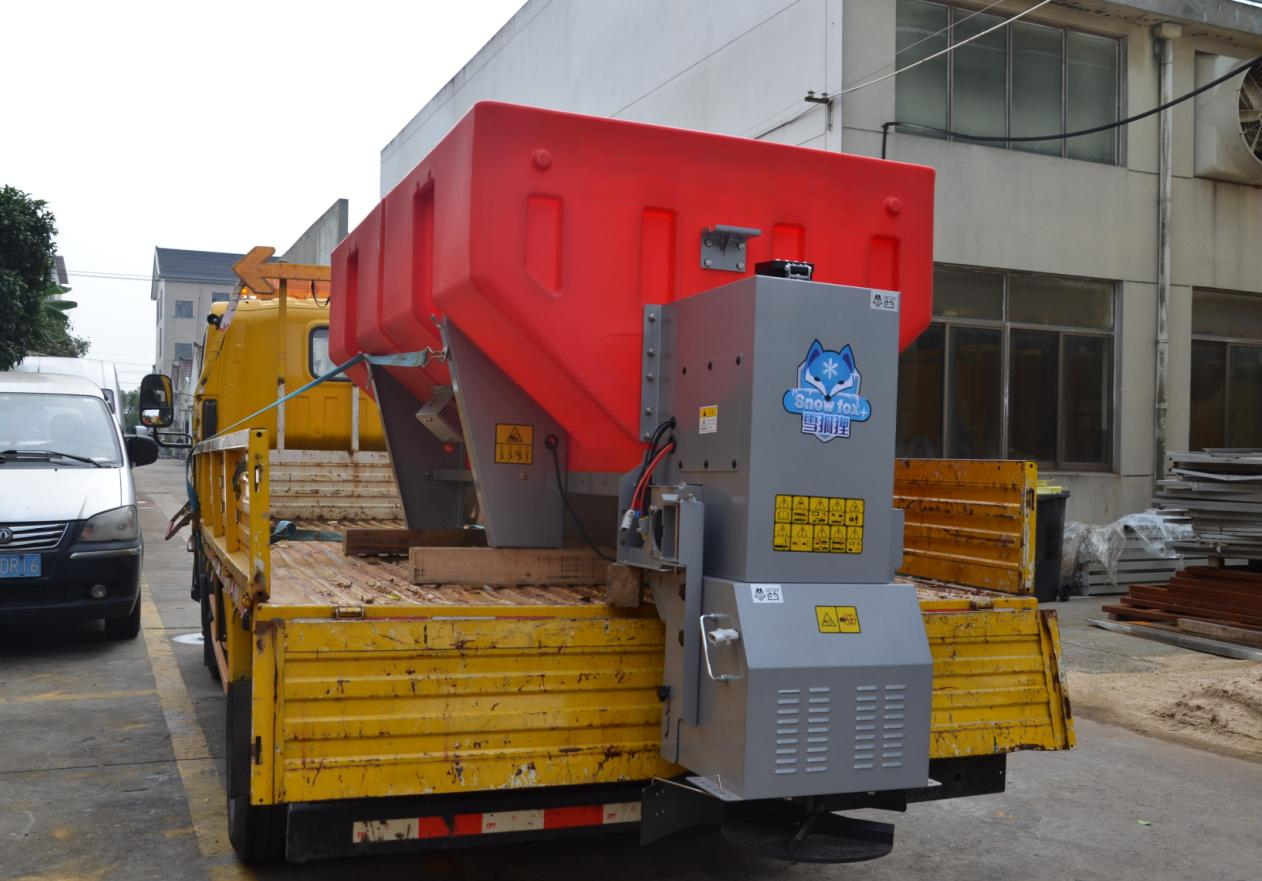
IV. Capability to Handle Extreme Operating Conditions
Low-Temperature Start-Up Assurance
Engine preheating function (enables normal starting at -30°C) + waterproof canopy with anti-caking design, ensuring continuous operation in extreme cold.
Complex Meteorological Response
Strong Wind Scenario: Lower the spreading height and increase material density to reduce drift.
Freezing rain scene: Switch to the de-icing agent spreading mode and increase the rotor speed to accelerate penetration.
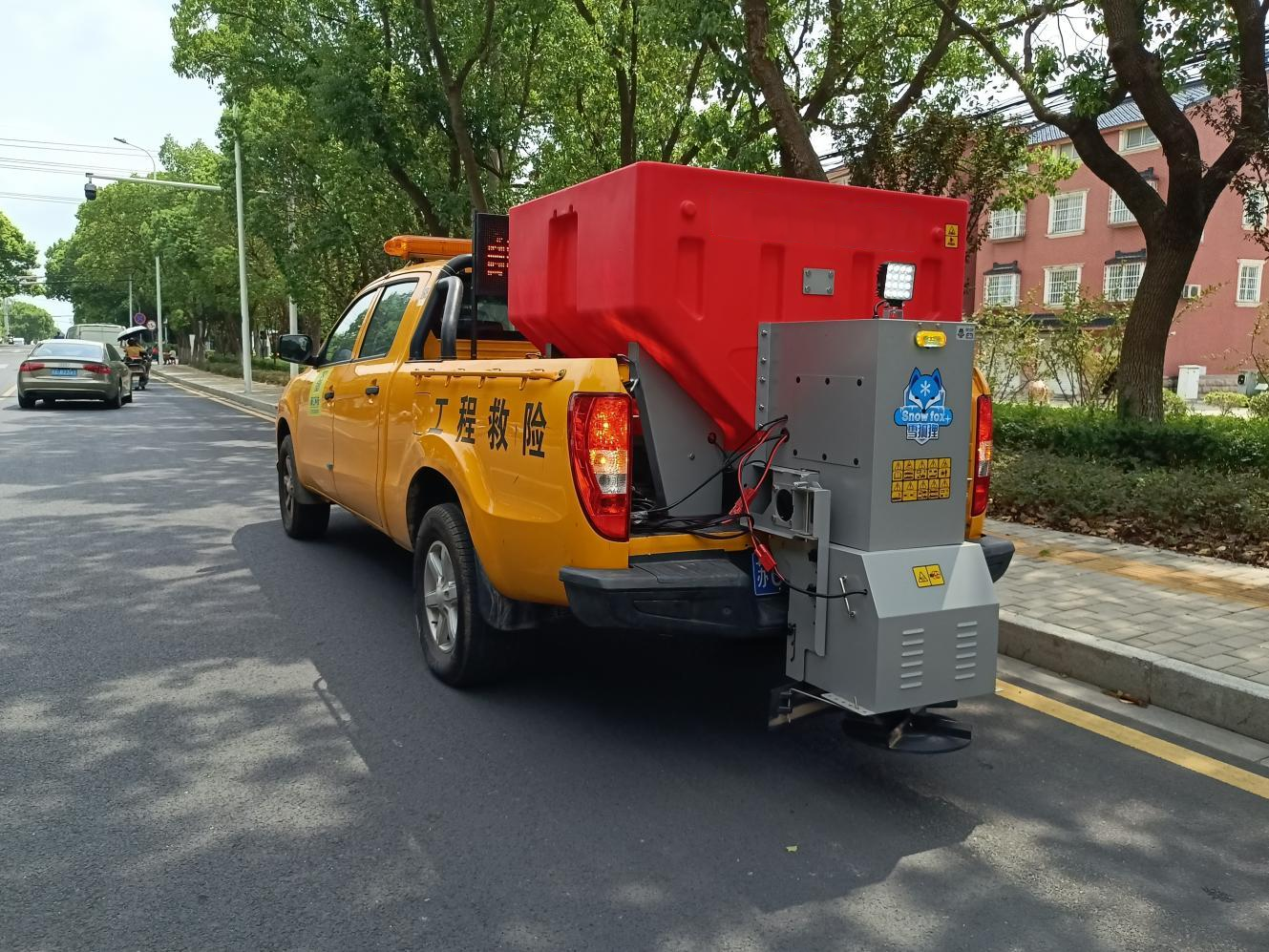
V. Energy Efficiency and Operations & Maintenance Optimization
Green Energy-Saving Technology
The DC geared motor draws power directly from the vehicle’s battery, reducing energy consumption by more than 40% compared with conventional gasoline‑powered systems.
Low-maintenance design
Anti-slip, maintenance-free scraper-chain conveyor with a modular quick‑release discharge pan mechanism, reducing downtime due to malfunctions.
Summary: Directions for Technological Iteration
The polyethylene snow-melting spreader builds adaptive capabilities through an “intelligent control kernel + flexible hardware platform”:
Short-term demand: Leverage existing sensor technologies (such as altitude and wind-speed sensing) to dynamically adjust parameters.
Long-Term Evolution: By deepening AI-driven decision-making and leveraging big data to forecast snowpack evolution, we are transitioning from “emergency response” to “risk prevention,” ultimately achieving the smart‑transportation goal of “zero‑delay road maintenance.”
Key words:
rotomolding airdrop box | safety protection box | server rack box | aviation aluminum box | cold chain insulation box | fire cart
RELATED INFORMATION



A production-oriented enterprise focusing on the research and development, design, customization, production, sales and service of special safety protection boxes; "armored shield" aims to provide integrated packaging protection solutions for major instrument and equipment manufacturers, aerospace, fire protection, medical and other industries.


Contact Us
Service Hotline: 139-1747-5956
Service Hotline:137-6128-2604
E-mail:sales@kldcases.com
Company address: 703A, Building A8, Kangqiao Business Oasis, caohejing, Pudong New Area, Shanghai
Factory address: 500 Yedao Road, Xitangqiao Town, Haiyan County, Jiaxing City, Zhejiang Province

Sweep and add WeChat
Learn more about products
Links: